

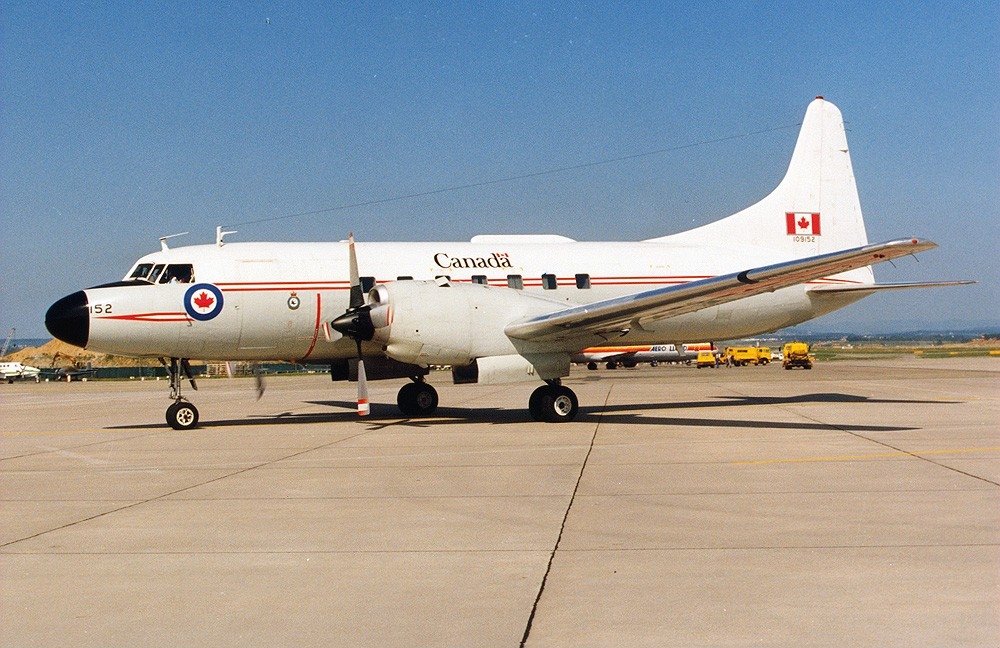
The Canadair CL-66 was a turboprop development of the civilian Convair CV-440 Metropolitan. In RCAF service, it was designated the CC-109 Cosmopolitan, more commonly known as the “Cosmo.” The type became the RCAF’s standard VIP transport and also took over light transport duties previously handled by the Douglas Dakota and the North American B-25 Mitchell. The CC-142 Dash 8 and CC-144 Challenger replaced the CC-109 well into the 1990s.
Design and development
When production of the Convair CV-440 ended in San Diego, Canadair purchased the design rights along with the jigs, tooling, and three unsold airframes. Around the same time, a turboprop conversion using the Napier Eland became available. These re-engined aircraft emerged as the CV-540, primarily intended for cargo operations.
The air force selected the Vickers Viscount, but the federal government declined to purchase it. In 1958, the RCAF began looking for a turbine-powered replacement for its aging C-47 Dakotas. Although the Vickers Viscount was selected by the air force, the federal government declined to purchase it. Canadair responded by proposing several CV-540-based variants powered by Napier Eland turboprops. The program was designated CL-66, with three versions planned.
The CL-66A was intended as a 48–64-seat passenger aircraft. The CL-66B was a mixed cargo-passenger variant with a payload of 14,200 pounds. The CL-66C consisted of Convair-built CV-440s modified at Canadair with only new engines.
The first CL-66 to fly was a C-model in February 1959, followed by the CL-66B in January 1960. The A-model never progressed beyond the proposal stage.
Operational history
Canadair was unable to secure orders from major airlines. The CL-66 proved costly, and competing aircraft offered better overall performance. Quebecair eventually purchased two CL-66C aircraft, which were used extensively for sales demonstrations.
The RCAF procured 10 aircraft, predominantly B-models. Operational service quickly highlighted shortcomings with the Napier Eland engine, which proved unreliable and failed to deliver its promised power. As a result, the RCAF initiated a re-engining program between 1966 and 1967, replacing the Elands with Allison 501-D36 engines. After eight aircraft were converted, further development was discontinued, leaving the remaining two Eland-powered airframes without support. Both were later scrapped.
No. 412 Squadron, based at CFB Ottawa (Uplands), operated the Cosmopolitan from 1960 until 1994 as the RCAF’s primary VIP transport. The type also supported Canadian NATO commitments in Europe and NORAD operations in the United States, giving the CC-109 a long and visible service life despite its limited production run.