
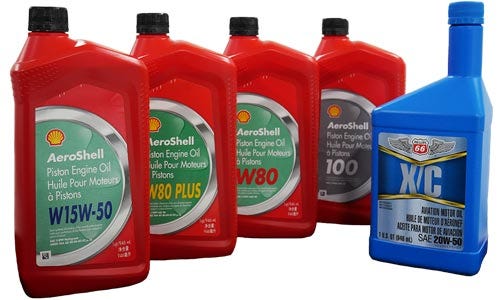
Oil is the lifeblood of your engine and is critical to its health and longevity.
Oil serves four functions: lubricates, cools, cleans, and seals, and is essential to the general functioning of your engine’s moving parts. Using the wrong grade of oil or poor oil management can impair one or more functions and cause engine damage.
Whether you are a knowledgeable owner changing your own oil regularly or someone who prefers to leave it to the AMEs, there are things you should know about the oil in your engine.
Viscosity
Viscosity rating is a measurement of a fluid’s resistance to flow. The thicker (higher viscosity) an oil is, the slower it will flow. Determining what type of viscosity, or weight, of oil to use is one of the most important factors when determining oil preference. The two main types of oil are single-weight oil and multi-weight oil.
For decades, single-weight oil was the only option available to aircraft operators. In the summer, owners would choose higher-weight oils such as 100 or 120. They would use this weight until the weather turned colder and subsequently switch to a lower weight oil such as 80.
During the cold winter months, you want to have low viscosity oil so that the oil can make its way through your engine as easily and quickly as possible to provide maximum protection. Using high viscosity oil when it is cold delays the travel of the oil through your engine which can cause metal-on-metal contact and possible subsequent engine damage. In addition, if the oil is too thick you can blow seals or develop other oil leaks.
Today we have multi-weight oils, such as 20W50 and 15W50. Multi-weight or multi-grade oil can act as both a high-weight and a low-weight oil. This, in turn, allows owners and operators the option to use one type of oil year-round. This feature simplifies things and saves us from trying to determine when to switch over or what type to keep in the back of the plane as a spare.
The main disadvantage is that multi-viscosity oil drains away from engine components more quickly than a single-grade oil. This can cause an issue with aircraft that are not flown regularly and sit for long periods.
When to change your oil
Change your oil according to the manufacturer’s recommendations… This is the most important factor when determining your oil change schedule. Oil, engine, and airframe manufacturers all provide information, but the airframe manufacturers’ instructions often win out.
Now, when to actually change your oil depends on many factors; you may need to change it sooner than recommended depending on flying conditions, but a major consideration is the type of filtration your engine utilizes.
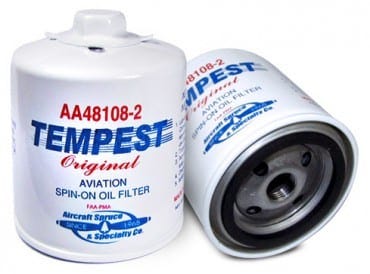
If your engine is equipped with the older metal screen-style filter, you should change your oil every 25 hours. Aircraft with modern spin-on-style filters often extend their intervals to 50 hours due to the higher filtration quality of newer filters.
While the 25- and 50-hour rules are fairly well known, one rule that is far less known is that you should change your oil every four months, regardless of flight time. This is because engine oil collects contaminants during engine operation, starting as soon as your engine fires up.
After four months, combustion by-products, water, and other contaminants can collect and become corrosive to your engine. This is even more important if your average flights are under an hour. Short flights don’t provide enough time to burn off any water in the oil. This water can accumulate and become corrosive. This is why it is recommended that you change your oil quarterly.
Oil Inspection
A routine inspection of your oil can also tell you a lot about how your engine is performing.
Inspecting your oil can alert you to potential engine issues before they become dangerous or costly. We all know that changing your filter at every oil change is vital, but it’s equally important to cut it open and check for any contaminants.
A magnet and a trained eye can tell a lot about what is happening in your engine. If you do your own oil changes but don’t know what to look for in your filter, take it to your regular maintenance facility and ask them to inspect it and go over with you what they find.
While a proper filter inspection is a valuable safeguard, you can take another step to provide even more information.
An engine oil analysis can help identify potential engine issues at a microscopic level. The analysis also serves as a source for trend monitoring. Regularly analyzing the oil allows you to monitor your engine’s health over time. Oil analysis often identifies major issues like camshaft wear or metal contamination long before a filter inspection does.
The low cost of analysis is a small price to pay for the peace of mind and knowledge that your engines are operating correctly.
Additives
There are various engine oil additives on the market. Owners with Lycoming engines know about Lycoming Service Instruction No. 1409C. This Service Instruction explains the use of oil additive LW-16702 to help reduce wear and corrosion within their engines.
Some oils, such as the Aeroshell W80 Plus, W100 Plus and Phillips 66 20W50 Victory products, contain this additive within the oil itself and don’t require that you use LW-16702 separately. Other oils do not include this additive and therefore need it to be added.
There are also various products, such as Avblend and Camguard, that contain additional additives to help reduce wear and improve engine operation. The use of these third-party additives can be a hot topic with many opponents and proponents alike.
My aircraft has a Continental 0-300, so I don’t need the Lycoming LW-16702 additive. I use Phillips 20W-50 oil and CamGuard at every oil change. I have found, from experience, that my engine performs better with this combination.
Oil is one of the most contested topics in aviation. From the preferred time between oil changes and the preferred weight to which brand of oil is best, a variety of “correct” answers arise. For more information, view your engine and airframe manufacturer’s recommendations and operating instructions.
To recap:
- Follow your manufacturer’s recommendations
- Inspect your filter at every change
- Perform regular oil analysis
- Fly often and long enough to help deter corrosion