Spend enough time looking through Canadian aviation history, and you will find no shortage of good aircraft that never made it into production. Some failed because the design did not work. Others arrived at the wrong time or simply ran out of money before they had a chance to prove themselves. The Trident TR-1 Trigull falls into that second group.
Designed and built in British Columbia during the 1970s, the Trigull was meant to be a modern replacement for the Republic RC-3 Seabee. It flew, completed certification in both Canada and the United States, and attracted more than 40 orders. By most measures, Trident Aircraft had done the hard part. What it could not do was find enough money to put the aircraft into production.
Today, the Trigull is largely forgotten outside a small group of amphibian owners and Canadian aviation history followers. That is unfortunate, because it was not simply another prototype that made a few test flights before disappearing. It was a well-developed, certified aircraft that came surprisingly close to becoming a Canadian production airplane.
Updating the Seabee
The Republic Seabee was one of those aircraft that looked unusual but was perfect for its purpose. It combined a boat-shaped hull, a high wing, a rear-mounted pusher engine, and retractable landing gear. Owners could operate it from a runway, taxi down a boat ramp, or land on a lake. That flexibility made it particularly well suited to Canada. The problem was that the Seabee had been designed during the Second World War and produced only briefly after it. By the late 1960s, its modest performance and aging systems left room for something newer.
Trident Aircraft was formed in British Columbia in February 1970 to fill that gap. The company began in the Vancouver area and later moved the program to Sidney, near Victoria International Airport and Patricia Bay. The resulting TR-1 kept the Seabee’s basic layout, including the high wing, hull, and pusher engine. Beyond that, however, it was a new aircraft. It used mainly aluminum construction, with fibreglass in the forward cabin and hull area, and was planned in four- and six-seat versions. With a wingspan of nearly 42 feet and a considerably more powerful engine, it was intended to be a useful travelling aircraft, not simply something to take out for an afternoon on the lake.
Some genuinely clever ideas
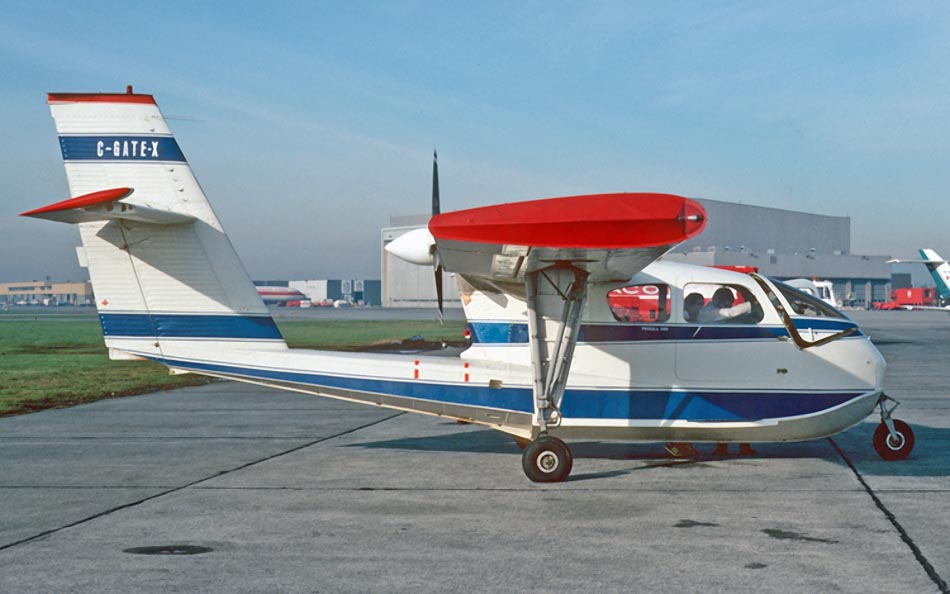
One of the most noticeable features of the Trigull was its retractable wingtip floats. Most flying boats utilize hard-mounted wingtip pontoons. They are essential on the water, but once the aircraft is airborne, they are mostly along for the ride, creating drag. Trident designed the TR-1’s pontoons to fold into the wingtips. When retracted, they formed part of the wing and contributed additional lifting area, much like its bigger cousin, the Canso.
The nose wheel also did more than support the aircraft on land. When retracted into the nose, it could act as a bumper while docking. Drooping ailerons worked with the flaps to improve low-speed lift, an important consideration when trying to get an amphibious hull unstuck from the water. The certified TR-1 Trigull 285 was powered by a 285-horsepower Continental Tiara 6-285 engine. A larger, six-seat Trigull 320 was planned with the 320-horsepower version.
For the 285, published performance included a cruise speed of approximately 148 mph, a maximum speed near 157 mph, and a range of roughly 450 nautical miles. Stall speed was listed at about 52 mph. Those were respectable figures for a four-place amphibian of the period and a noticeable improvement over the original Seabee. The Tiara engine, however, would become one more challenge. Continental developed it as a modern, geared six-cylinder engine, but the line never gained the market acceptance needed to remain in production. Trident later looked at Lycoming IO-540 and turbocharged TIO-540 installations, which would have given the aircraft a much better long-term support network.
The Trigull takes flight
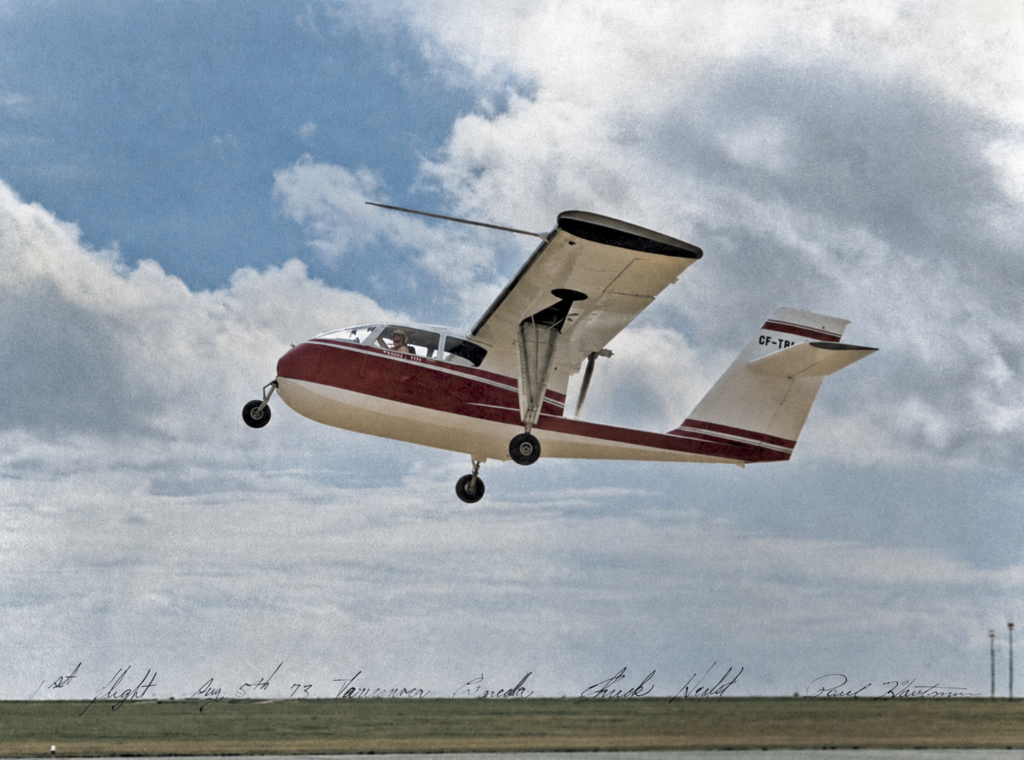
The first prototype was registered CF-TRI-X and flew for the first time on August 5, 1973. Canadair test pilot Paul A. Hartman and Trident engineer Chuck Herbst were aboard. The prototype went on to accumulate hundreds of test hours while the design was refined and worked toward certification. Three Trigull airframes were ultimately built. The first and third flew, while the second was used for structural and engineering testing. The third aircraft, registered C-GATE, made its first flight on July 2, 1976.
On October 28 of that year, the Trigull 285 received its Canadian type certificate. U.S. Federal Aviation Administration certification followed on December 16. The company was not working alone. Canadair and Grumman Aerospace provided technical assistance, while the federal Ministry of Industry, Trade and Commerce and the British Columbia Development Corporation provided financial support. There also appeared to be real customer interest. Trident reportedly had orders for 43 aircraft, along with 23 options. For a new company selling a specialized amphibian, that was not an insignificant order book.
So what went wrong?
Getting an aircraft certified and building it in quantity are two very different problems. Certification proves that the design meets the required standards. Production requires tooling, facilities, trained employees, inventory, suppliers, and enough cash to keep paying for all of it until completed aircraft begin generating revenue. That gap has ended more than one promising aviation program.
Trident reached this milestone at a particularly difficult time. The general aviation market was weakening toward the end of the 1970s. Fuel prices were rising, interest rates were climbing, and buyers were becoming cautious. At the same time, the company still needed substantial funding to move from hand-built prototypes to production aircraft.
The problems surrounding the Continental Tiara did not help. A new aircraft is already a risk for a buyer. Pairing it with an engine that had an uncertain future added another concern. Despite government support, technical assistance, and customer orders, Trident could not raise enough capital to complete the transition. The company ceased operations in 1980. Production never began. In the end, only the three prototypes were built.
The story did not end in 1980
Viking Air of Sidney eventually acquired the Trigull type certificate and the two surviving prototypes. Few companies would have been better suited to recognize the aircraft’s potential. Viking built its reputation supporting older Canadian aircraft and later returned the DHC-6 Twin Otter to production.
In 2003, Viking considered reviving the Trigull with turbine power. The idea made sense. A turbine engine, modern avionics, and updated systems could have addressed many of the support concerns that worked against the original aircraft. Nothing came of the proposal, and no new Trigulls were built. In August 2024, the type certificate was transferred to De Havilland Aircraft of Canada as assets within the Viking organization were consolidated. There has been no indication that De Havilland plans to restart the program.
One of the surviving aircraft, C-GATE, is now displayed at the British Columbia Aviation Museum near Victoria International Airport. It remains close to where much of the development work took place. Looking at the Trigull today, it is hard not to wonder what might have happened had the aircraft arrived a few years earlier or if Trident had secured enough money to begin production. Canada has the geography for an aircraft like it, and the continued popularity of Seabees, Lake amphibians and other water-capable aircraft shows that the market never disappeared entirely. That may be the most Canadian part of its story. We have often been excellent at designing aircraft for the conditions in which we operate. Keeping those aircraft funded and in production has frequently proved to be the harder part.